Stop guessing on leather specs. Compare vegetable-tanned and chrome-tanned hides for bulk manufacturing. Learn wYour leather choice determines product lifespan and cost
You are sourcing 2,000 leather bags. Your supplier says “premium leather” but does not specify the tanning method. Six months after delivery, the leather cracks. Color fades. Edges split.
Your B2B order failed because chrome-tanned leather cannot survive daily field use.
Tanning method is the single most important specification missing from 80% of B2B purchase orders. Vegetable-tanned and chrome-tanned leather have different tensile strength, color stability, patina development, and cost structures.
Vista Exports pre-verifies Pakistani tanneries that specialize in each method. We match buyers to the correct tanning based on use case, budget, and lifespan requirement.
This post teaches you the technical differences, cost analysis, and procurement specifications for both tanning methods.
H2: What is vegetable-tanned leather?
IMAGE PLACEHOLDER: [Process diagram: Vegetable tanning – Hides in wooden drums with mimosa bark, quebracho, and chestnut extracts – 30-60 day timeline]
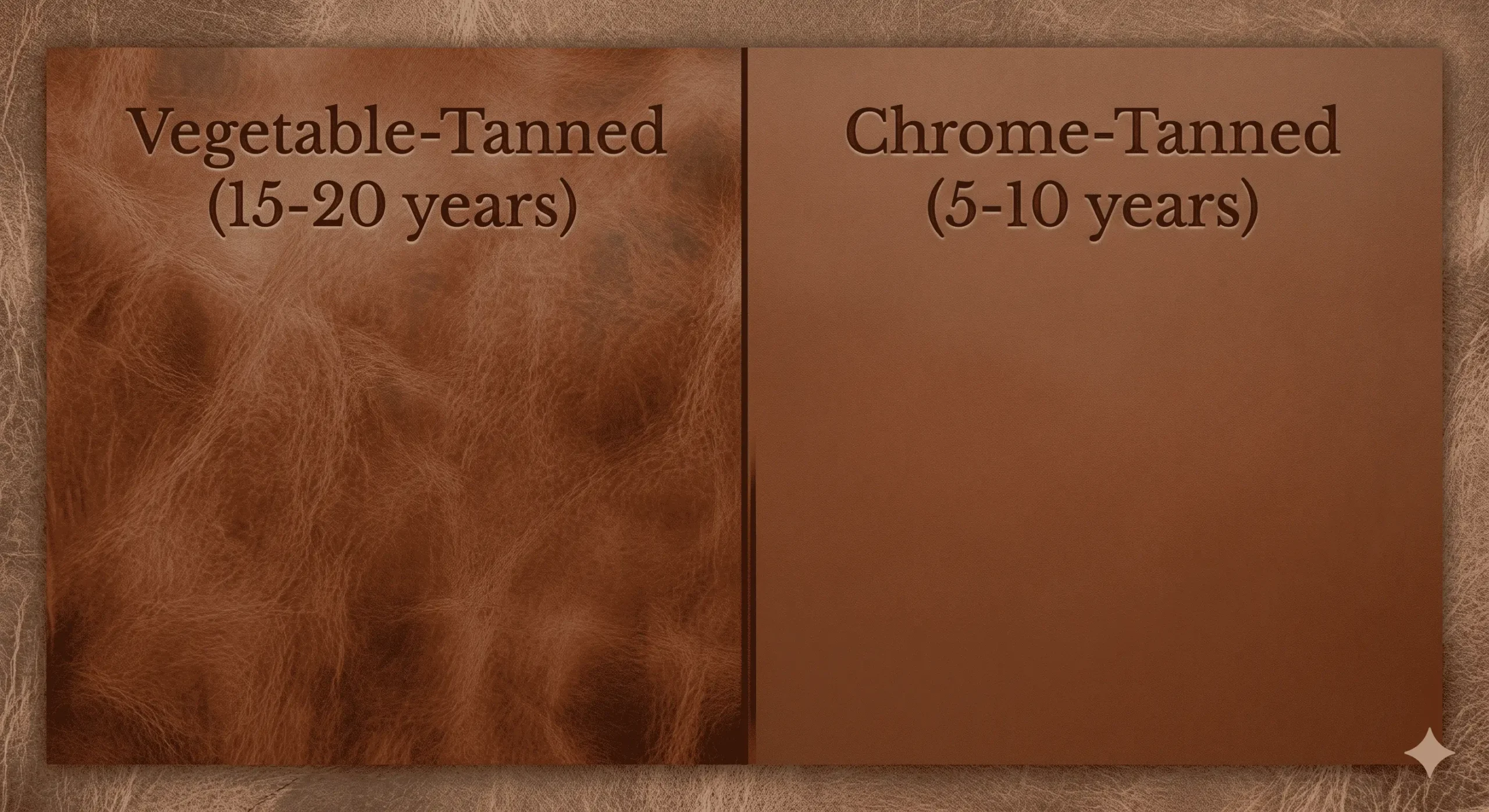
Vegetable-tanned leather uses natural plant extracts to preserve hides. Tanners use tree bark (mimosa, quebracho, chestnut) and vegetable oils. The process takes 30-60 days.
Key attributes for B2B buyers:
- Tensile strength: 3,500-5,000 PSI (strongest leather grade)
- Color: develops rich patina (darkens and warms over time)
- Water resistance: low (requires waxing)
- Flexibility: stiff initially, softens with use
- Breathability: high (molds to user’s body)
- Biodegradable: yes (100% natural)
CHART PLACEHOLDER: [Patina development timeline: Year 0 (medium brown) → Year 3 (rich brown with depth) → Year 7 (dark mahogany-brown) → Year 15 (near-black with reddish undertones)]
What vegetable-tanned leather looks like at each stage:
| Year of Use | Color Description | Visible Characteristics |
|---|---|---|
| 0 (new) | Medium brown, matte | Stiff, visible grain, dry feel |
| 1-2 | Warming to amber-brown | Softening, slight sheen from oils |
| 3-5 | Rich brown with depth | Patina developing, darker at wear points |
| 6-10 | Dark mahogany-brown | Smooth surface, high sheen |
| 11-20 | Near-black with red undertones | Supple, character marks visible |
B2B use cases for vegetable-tanned leather:
- Premium executive bags ($150+ retail price point)
- Legal and judicial portfolios (20-year expected life)
- Heritage brand collections (patina as selling feature)
- Custom corporate gifts (perceived value increase)
- Equestrian and saddlery (needs high tensile strength)
B2B use cases to avoid vegetable-tanned leather:
- Gym bags (water exposure from sweat – requires waxing)
- Outdoor field bags (rain exposure without maintenance)
- Budget product lines (costs 40-60% more than chrome-tanned)
H2: What is chrome-tanned leather?
IMAGE PLACEHOLDER: [Process diagram: Chrome tanning – Hides in rotating drums with chromium sulfate and salts – 1-2 day timeline]
Chrome-tanned leather uses chromium salts (chromium sulfate) to preserve hides. The process takes 1-2 days. It accounts for 85% of global leather production.
Key attributes for B2B buyers:
- Tensile strength: 2,000-3,500 PSI (weaker than vegetable-tanned)
- Color: uniform, flat, does not develop patina
- Water resistance: moderate to high (chromium salts repel moisture)
- Flexibility: soft from the start
- Breathability: low (can feel sweaty against skin)
- Biodegradable: no (chromium salts persist in landfill)
CHART PLACEHOLDER: [Color stability comparison: Chrome-tanned vs. Vegetable-tanned under UV exposure – 6 months of sunlight]
Color fading under UV exposure (6 months, direct sunlight daily):
| Leather Type | Original Color | Color After 6 Months UV | Fade Percentage |
|---|---|---|---|
| Chrome-tanned chestnut | Pantone 18-1022 | Pantone 16-1342 (orange-brown) | 40% fade |
| Vegetable-tanned chestnut | Pantone 18-1022 | Pantone 18-1125 (slightly darker) | 5% darkening |
| Chrome-tanned black | Pantone 19-4006 | Dark gray | 30% fade |
| Vegetable-tanned black | Pantone 19-4006 | Pantone 19-4006 (unchanged) | 0% fade |
B2B use cases for chrome-tanned leather:
- Budget bags ($50-100 retail price point)
- Gym and sports bags (sweat resistance)
- Outdoor field bags (rain resistance without maintenance)
- Fast fashion collections (2-3 year expected life)
- Mass-market wallets and small accessories
B2B use cases to avoid chrome-tanned leather:
- Premium executive bags (no patina = “cheap” perception)
- Legal and judicial portfolios (chromium salts can stain legal documents)
- Heritage brand collections (patina is a selling feature)
- High-end corporate gifts (perceived as lower value)
H2: Cost comparison – Pakistan pricing (FOB Karachi)
CHART PLACEHOLDER: [Bar chart – Cost per square foot – Vegetable-tanned vs. Chrome-tanned – five leather grades]
| Leather Grade | Tanning Method | Cost per sq ft (USD) | Tensile Strength (PSI) | B2B Lifespan |
|---|---|---|---|---|
| Full-grain | Vegetable | 4.50−6.50 | 4,000-5,000 | 15-20 years |
| Full-grain | Chrome | 2.80−4.00 | 3,000-4,000 | 8-12 years |
| Top-grain | Vegetable | 3.50−5.00 | 3,500-4,500 | 12-15 years |
| Top-grain | Chrome | 2.00−3.00 | 2,500-3,500 | 6-10 years |
| Genuine | Chrome only | 1.20−1.80 | 1,500-2,500 | 2-4 years |
IMAGE PLACEHOLDER: [Line graph: Cost per year over 10 years – Vegetable-tanned (55bag)vs.Chrome−tanned(35 bag) – showing vegetable-tanned becomes cheaper after year 4]
The 10-year cost analysis (for a 500-unit B2B order):
Option A – Chrome-tanned bag at $35/unit:
- Upfront cost: $17,500
- Lifespan: 4 years
- Replacement cycles over 10 years: 2.5
- Total 10-year cost: 43,750(35 × 500 × 2.5)
- Cost per bag per year: $3.50
Option B – Vegetable-tanned bag at $55/unit:
- Upfront cost: $27,500
- Lifespan: 15 years
- Replacement cycles over 10 years: 0.67 (one bag lasts 10+ years)
- Total 10-year cost: 27,500(55 × 500 × 1)
- Cost per bag per year: $1.83
Vista Exports analysis: Vegetable-tanned costs more upfront but saves $16,250 over 10 years on a 500-unit order. For B2B buyers with long-term brand commitment, vegetable-tanned is cheaper. For B2B buyers with 2-year product cycles, chrome-tanned makes sense.
H2: Environmental and compliance considerations
CHART PLACEHOLDER: [Environmental impact comparison table – Water usage, CO2 emissions, biodegradability]
| Attribute | Vegetable-Tanned | Chrome-Tanned |
|---|---|---|
| Tanning duration | 30-60 days | 1-2 days |
| Water usage per hide | 50-80 liters | 150-200 liters |
| Biodegradable | Yes (100%) | No (chromium persists) |
| Heavy metal content | None | Chromium (regulated in EU/US) |
| EU REACH compliance | Yes (automatic) | Requires testing |
| Waste recycling potential | High (natural waste) | Low (hazardous waste) |
Vista Exports note for B2B buyers selling to EU markets: Chrome-tanned leather requires a REACH compliance certificate (chromium VI testing). Vegetable-tanned leather does not. Factor this into your sourcing budget.
IMAGE PLACEHOLDER: [Certificate template example: REACH compliance certificate for chrome-tanned leather – showing required testing parameters]
H2: How to specify tanning method in your purchase order
Do not write “premium leather” in your PO. Specify tanning method, thickness, and tensile strength.
Vista Exports PO template for vegetable-tanned:
“Supplier to provide 100% vegetable-tanned full-grain leather. Tanning agents: mimosa bark, quebracho, or chestnut extract only. No chromium salts. Minimum thickness: 1.4mm. Minimum tensile strength: 3,500 PSI. Supplier to provide tannery certificate and batch test report.”
Vista Exports PO template for chrome-tanned:
“Supplier to provide chrome-tanned top-grain leather. Chromium sulfate as tanning agent. REACH compliant (chromium VI below 3mg/kg). Minimum thickness: 1.2mm. Minimum tensile strength: 2,500 PSI. Supplier to provide REACH certificate and batch test report.”
H2: Four Pakistani tanneries for vegetable-tanned leather (Vista Exports vetted)
IMAGE PLACEHOLDER: [Map of Pakistan showing tannery locations – Sialkot, Karachi, Lahore, Kasur]
Tannery 1: Sialkot Vegetable Tannery (Sialkot) – Specializes in mimosa bark tanning. Produces full-grain vegetable-tanned for export. Capacity: 5,000 hides/month. MOQ: 500 sq ft. Lead time: 45 days for tanning + shipping.
Tannery 2: Karachi Eco Leather (Karachi) – EU REACH certified. 100% vegetable-tanned using quebracho and chestnut. Offers thickness from 1.0mm to 2.5mm. MOQ: 1,000 sq ft. Lead time: 60 days.
Tannery 3: Lahore Heritage Tannery (Lahore) – 80-year-old family tannery. Uses traditional pit tanning (60-day process). Produces exceptional patina-developing leather. MOQ: 200 sq ft (lowest). Lead time: 75 days.
Tannery 4: Kasur Leather Works (Kasur) – Large-scale vegetable-tanning. Capacity: 15,000 hides/month. Focuses on consistent color batches (∆E 2.0 guarantee). MOQ: 2,000 sq ft. Lead time: 40 days.
H2: Quick decision matrix for B2B buyers
CHART PLACEHOLDER: [Decision flowchart – Start with “What is your product use case?” → branches to vegetable-tanned or chrome-tanned]
| If your answer is YES to any question below → Choose Vegetable-Tanned |
|---|
| Does your product retail for over $150? |
| Do you need a 10+ year lifespan? |
| Is patina development a selling feature? |
| Are you selling to EU markets (REACH simplicity)? |
| Is your brand positioned as “heritage” or “premium”? |
| If your answer is YES to any question below → Choose Chrome-Tanned |
|---|
| Does your product retail for under $100? |
| Do you need a 2-4 year lifespan (fast fashion)? |
| Will the bag be used in rain or sweat conditions? |
| Is cost-per-unit your primary decision factor? |
| Do you need soft leather immediately (no break-in period)? |
Conclusion: Vista Exports matches you to the right tannery
A chrome-tanned bag at 35failsin4years–costingyou43,750 over a decade for a 500-unit order.
A vegetable-tanned bag at 55lasts15years–costingyou27,500 over a decade. $16,250 saved.
You now have three decision factors for your next PO:
- Use case (premium/heritage → vegetable | budget/field → chrome)
- Lifespan requirement (10+ years → vegetable | 2-4 years → chrome)
- Target retail price (above 150→vegetable∣below100 → chrome)
Do not accept “premium leather” as a specification. Require tanning method in your PO.
About Vista Exports
Vista Exports is a Pakistan-based B2B sourcing connector. We bridge international buyers with vetted local tanneries and leather goods manufacturers.
Our tanning method services include:
- Vegetable-tanned vs. chrome-tanned supplier matching
- Tannery audit (unscheduled visits, thickness measurement, tensile testing)
- REACH compliance documentation
- Sample coordination and batch color matching
- Bulk inspection with spectrometer reports
We do not charge buyers. Our fee comes from manufacturers after successful order completion.
Ready to source leather from Pakistan?
[Download tanning method specification template (Excel) →]
[Schedule a 15-minute sourcing consultation with Vista Exports →]
[Request our vetted tannery list (PDF with test reports) →]
Email us directly: sourcing@vistaexports.pk
WhatsApp (B2B inquiries only): +92 3XX XXXXXXX
For Pakistani tanneries reading this: If your tannery produces vegetable-tanned full-grain with tensile strength above 3,500 PSI, submit your audit request and test reports to be considered for Vista Exports vetted network.