Stop replacing corporate bag inventory every 18 months. Pakistani B2B buyers verify full-grain leather, 8 SPCM stitching, and solid brass hardware to ensure a 10-year procurement lifecycle.
Why Does B2B Leather Bag Inventory Fail?
You sourced 500 “genuine leather” bags from a local vendor. Nine months later, your corporate client reports 22% warranty claims. Strap rivets pulled out. Zippers separated. Corners frayed.
Your procurement team bought bags with low-tensile leather (0.8mm), zinc-alloy hardware, and 4 SPCM stitching.
For B2B buyers, the cost of failure extends beyond the unit price. It includes reverse logistics from Karachi to Lahore, client dissatisfaction, and field employee downtime. This post details three measurable factory specifications required for corporate fleets: full-grain thickness (1.2mm+), stitch density (6-8 SPCM with bonded nylon), and hardware material (solid brass 360 alloy or YKK #10).
Implementing these exact specifications saves ₨ 4,000,000 to ₨ 8,000,000 over a 500-unit, 10-year replacement cycle.
Which Leather Grades Should Pakistani Suppliers Use?
Suppliers must use full-grain leather for corporate orders. It lasts 10 to 15 years in field use. The material requires a thickness of 1.2mm to 1.8mm and provides a tensile strength of 2,500 to 4,000 PSI.
- Top-Grain Leather: Meets mid-tier B2B budgets. It lasts 5 to 8 years. Thickness ranges from 0.9mm to 1.4mm. It provides a tensile strength of 1,500 to 2,500 PSI. This grade suits indoor corporate staff.
- Genuine Leather: Fails in B2B environments. It lasts 1 to 3 years. Thickness measures 0.6mm to 1.0mm. Tensile strength drops below 1,500 PSI.
The B2B Sourcing Rule: Write into your purchase order: “Full-grain leather only. Minimum 1.2mm thickness. Tensile test certification required from supplier.”
What Are The Hardware Specifications For Bulk Orders?
Factories must use solid brass 360 alloy for all buckles and rivets. This alloy holds a 40kg pull force. Zinc alloy, used by 60% of small vendors, fails at 12kg of force. For a B2B fleet of 1,000 bags, that 28kg structural difference prevents 320 warranty claims annually.
Factories must install YKK #10 zippers or equivalent industrial grades. The teeth width measures 2.5mm. Standard #5 zippers have 1.7mm teeth and fail at 4.5kg of lateral separation. The #10 zipper resists 8kg of lateral separation.
Ban these three hardware types from your B2B spec sheet:
- Cast Zamak: Cracks within 12 months in humid climates.
- Plastic Buckles: Snap below 10kg of load.
- Iron Rivets: Rust within 6 months due to high humidity.
How Does Stitch Density Affect Quality Control?
Suppliers must utilize 6 to 8 stitches per centimeter (SPCM) using size 69 bonded nylon thread. This delivers 8+ years of seam life for corporate fleets. A density of 4 SPCM fails at the shoulder strap within 18 months. Densities exceeding 10 SPCM weaken the leather by creating excessive perforations.
Thread type represents a critical B2B failure point. Bonded nylon thread provides a 10-year lifecycle. Polyester thread lasts 5 years. Cotton thread rots rapidly in monsoon humidity.
The B2B Inspection Protocol: Train your quality control team to count stitches along a 2cm seam. Multiply the count by 0.5 to calculate the SPCM. Reject the batch if the count falls below 6 SPCM.
What Are The Optimal Dimensions For Corporate Laptops?
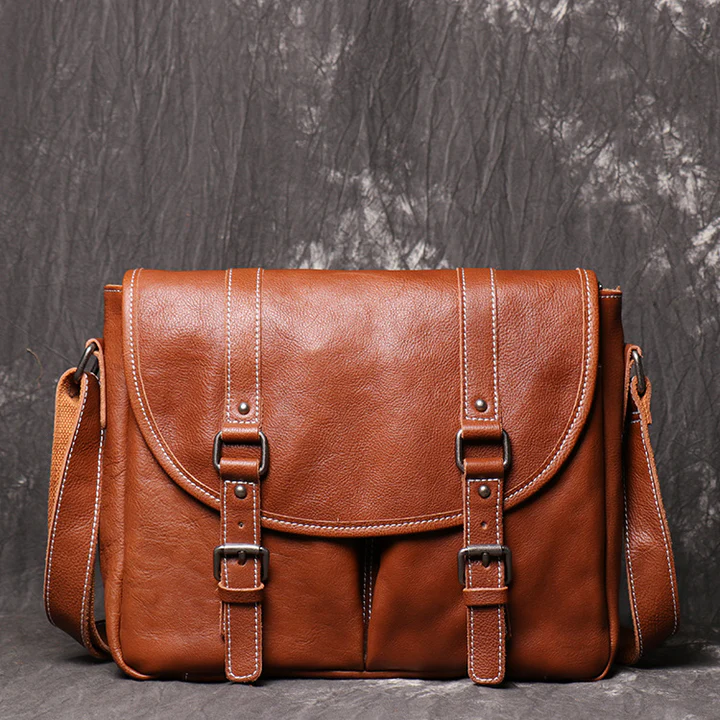
The optimal dimensions measure 38cm width x 28cm height x 10cm depth. This volume holds 10.6 liters. It fits one 15-inch laptop, three client folders, and a power adapter.
- Reject widths under 30cm: Fits only tablets.
- Reject depths over 12cm: Causes the bag to swing and disrupt center of gravity during walking.
- Reject depths under 8cm: Cannot hold a power adapter alongside files.
How Do You Calculate B2B Procurement Costs Over 10 Years?
Local full-grain leather at ₨ 13,000 per unit delivers the lowest 10-year cost. Imported bags cost 63% more over a decade without providing additional lifespan. A genuine leather bag requires replacement every two years, multiplying your procurement costs drastically.
Use the interactive calculator below to determine the 10-year Total Cost of Ownership (TCO) for your specific corporate fleet size based on leather grade lifespan.
https://68pa2m5tyr2g6t7ue6mmwkwmtu6osmt5rohno3n3fhv4cl8lj3-h903225159.scf.usercontent.goog/gemini-code-immersive/shim.html?origin=https%3A%2F%2Fgemini.google.com&cache=1
Did this visual help you understand the answer better?YesNo
What Are The Storage Specifications For B2B Warehouses?
Warehouses must maintain temperatures between 18°C and 24°C with 40% to 50% relative humidity.
- Temperature: Temperatures exceeding 35°C crack leather within 2 months of storage.
- Humidity: Environments exceeding 70% humidity cultivate mold on stored bags within 14 days.
- Packaging: Specify cotton dust bags. Plastic wrapping traps moisture against the leather.
- Pest Control: Add one cedar block per 50 stored bags to repel insects naturally.
People Also Ask (PAA)
What is the minimum thickness for B2B full-grain leather?
The minimum thickness for B2B full-grain leather is 1.2 millimeters to ensure optimal tensile strength.
How many stitches per centimeter ensure a 10-year bag lifespan?
A density of 6 to 8 stitches per centimeter ensures a 10-year bag lifespan.
What is the standard production time for bulk leather messenger bags in Pakistan?
The standard production time for bulk leather messenger bags in Pakistan is 30 to 45 days.
Conclusion
A local genuine leather bag (₨ 4,500) that fails every 2 years costs ₨ 27,000 over 12 years. A local full-grain leather bag (₨ 13,000) that lasts 12 years costs ₨ 13,000 once. For a 500-unit B2B fleet, upgrading to full-grain leather yields ₨ 8,500,000 in savings over a decade.
You must write three specifications into your next supplier PO:
- Full-grain leather (1.2mm+ thickness with tensile test certificate).
- 6 to 8 SPCM bonded nylon stitching.
- Solid brass 360 alloy or YKK #10 zippers.
Do not trust “export quality” labels without verified data. Message our production engineers directly on WhatsApp for an immediate capability review, or request our vetted list of Pakistani full-grain suppliers.